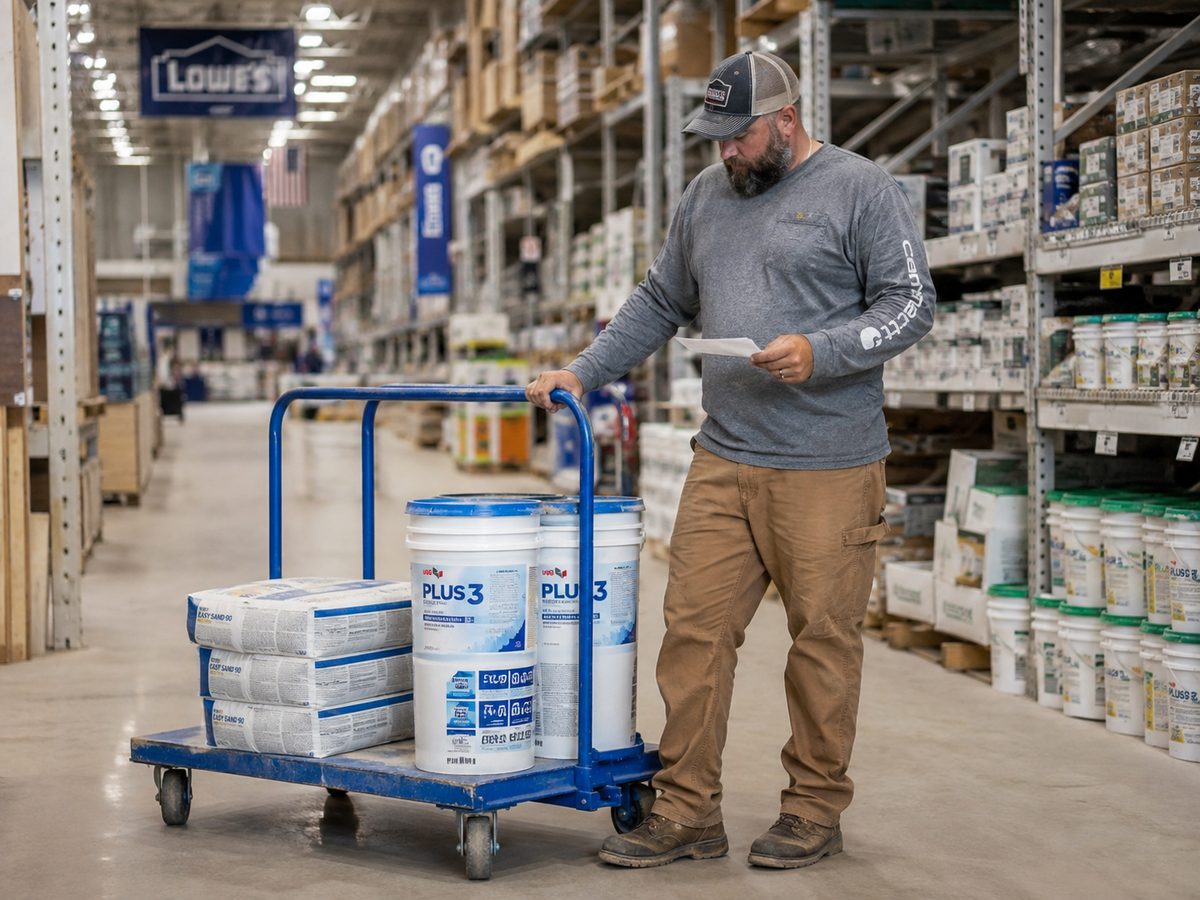
Lowe's just notched its fifth straight quarter of positive comparable sales, and the headline earnings number beat expectations. Look past both facts and the picture gets more complicated. Revenue missed what analysts had modeled, full-year guidance moved to the low end of every range the company had given itself, and a meaningful piece of the earnings beat came from a tariff refund that will not repeat. The real question for investors is whether Lowe's professional and online customers can keep growing fast enough to cover for a do-it-yourself shopper who is still pulling back.
The Beat Depends on Which Earnings Number You Use
Lowe's reported adjusted diluted EPS of $4.40, ahead of a $4.22 consensus estimate, a beat of roughly 4%. GAAP diluted EPS came in at $4.27, flat against the same quarter last year. The gap between those two numbers matters: adjusted EPS excludes roughly $96 million of costs tied to two recent acquisitions, Foundation Building Materials and Artisan Design Group, and separately includes about $0.11 per share, roughly $80 million, from tariff refunds. Strip that refund out and the adjusted beat shrinks close to in line with expectations. Revenue of $25.956 billion, meanwhile, missed the roughly $26.1 billion consensus by about 0.7%, even as it grew 8.3% year over year, a growth rate that leans heavily on the two acquisitions layered into this year's results.
That is not a clean beat by any single measure. The adjusted profit number cleared the bar, the GAAP profit number did not grow at all, and the top line came in lighter than modeled.
Comparable Sales Depend on Three Divisions, Not the Company's Largest One
Comparable sales rose 0.2% for the quarter, extending a streak that now spans five consecutive periods of positive growth. Chief executive Marvin Ellison credited "sustained growth in Pro, Online and Home Services" for that streak, while acknowledging "pressure in discretionary DIY spending" in the same breath. That is a fair summary of the underlying data: the parts of Lowe's business built around professional contractors, digital sales, and installation services are growing, while the traditional homeowner walking into a store for paint or a grill is spending less.
Online sales grew 15.7% year over year, the fastest-growing channel in the disclosed results, reflecting a multi-year shift in how home-improvement customers shop rather than a one-quarter anomaly. Whether it is growing fast enough to keep offsetting DIY softness through the back half of the year is the question management's own guidance narrowing suggests it is not yet ready to answer with confidence.
Guidance Moved to the Low End of Every Range
Full-year sales guidance narrowed to about $92.0 billion from a prior range of $92.0 billion to $94.0 billion, meaning the top of the range was removed rather than the whole range shifting lower. Comparable-sales guidance narrowed to flat from a prior flat-to-2% range. Adjusted operating margin guidance narrowed to about 11.6% from 11.6% to 11.8%, and adjusted diluted EPS guidance narrowed to about $12.25 from $12.25 to $12.75. In every case, the company kept the low end of its prior range and cut away the upside, a more cautious signal than a simple guidance cut, since it says the odds of beating expectations have fallen even if demand itself has not deteriorated further.
Lowe's guidance explicitly assumes no repeat of this quarter's tariff-refund benefit in the second half of the year, which makes the underlying comparable-sales and margin trajectory, not the adjusted EPS figure, the number to track from here.
The Margin for Error Just Got Smaller
Lowe's has built a credible growth engine around professional customers, online sales, and installation services, and that engine has carried five straight quarters of positive comps through a period of soft discretionary home spending. Revenue still missed expectations this quarter, GAAP profit did not grow, and management narrowed rather than reaffirmed its outlook, all in the same quarter that included a tailwind that will not repeat. The next test is straightforward: whether DIY spending stabilizes, whether online growth keeps adding to store traffic rather than substituting for it, and whether the recently acquired building-materials and design businesses can grow through a soft housing market rather than being weighed down by it.